The E-Commerce Data Gap 2026 - Tracking Maturity In Review
The E-Commerce Data Gap 2026 - Tracking Maturity In Review
"A year ago, we asked ourselves what the typical tracking setup in DACH e-commerce actually looks like. We can now say: The gap has narrowed, but it has not closed at all."
Timo Aden | Co-Founder / Managing Director Digitl
What You Will Learn
One year ago, we analysed 418 e-commerce websites in Germany, Austria and Switzerland. We found a clear gap: only about one in four companies with a professional tag management setup used server-side tagging. This year we went back to the same companies to see whether the market has moved.
It has. Among companies with Google Analytics and Google Tag Manager, the share using server-side tagging rose from 24.1% to 31.2%. Consent Mode v2 is widely in place. Still, two in three companies with GA and GTM collect data without server-side tagging. That is where the competitive advantage begins.
Download the study as a PDF here.
Methodology
- We ran a technical review of the same leading e-commerce companies in Germany, Austria and Switzerland as in the first edition (418). Three of them could no longer be measured reliably, so the analysis base is 415 companies.
- We again analysed each website by inspecting its network requests. New this year: we measured every site twice, once in its default state with no consent given and once after consent. The figures refer to the state after consent.
- Detection criteria:
- Google Analytics (GA): a gtag/js request URL
- Google Tag Manager (GTM): a gtm.js request URL
- Server-Side Tagging (SST): a server-side request URL on a custom domain
- Consent Mode v2: the gcd parametest
- The analysis did not focus on non-Google products such as Adobe or Tealium.
- Prior-year figures were recalculatof 415 companies, so they differslightly from the first edition.
Key Findings
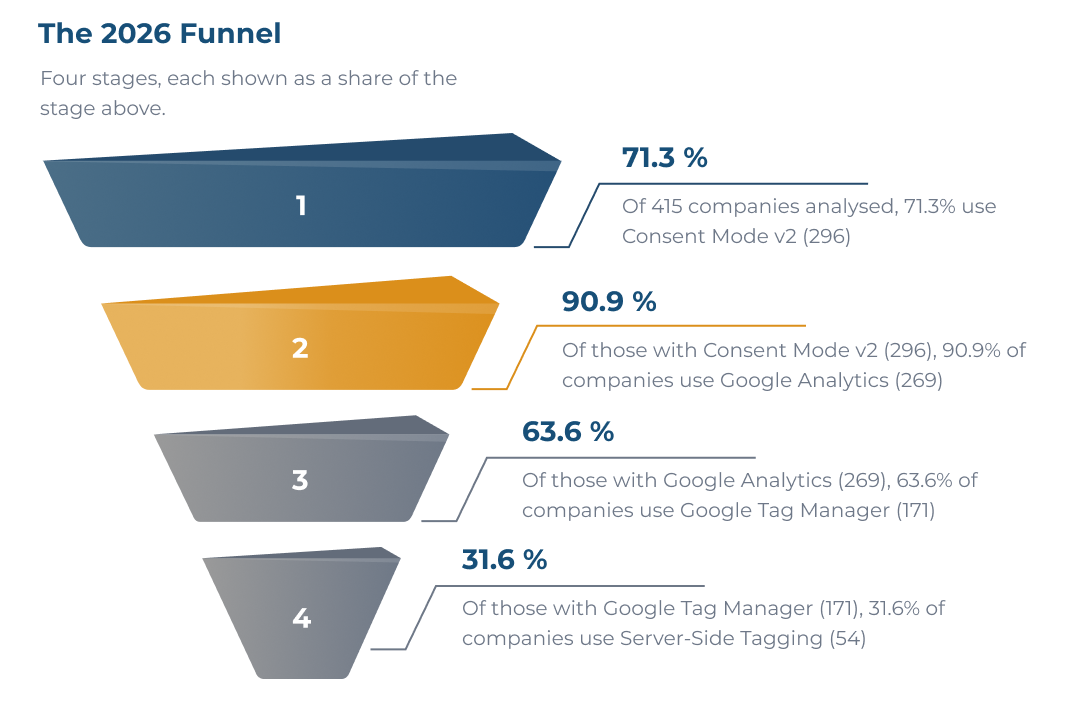
- The consent foundation is broad: 71.3% of the companies analysed send consent signals in line with Consent Mode v2.
- Almost all of them measure: 90.9% of companies with Consent Mode v2 use Google Analytics.
- Central management thins out: 63.6% of those companies use Google Tag Manager.
- Server-side tagging is the rarest step: only 31.6% of companies with Consent Mode v2, Google Analytics and GTM use it. Out of 415 companies, 54 reach the final stage.
Executive Summary
Server-side tagging is on the rise: from just under a quarter to just under a third. Among companies with GA and GTM, the share using server-side tagging rose from 24.1% to 31.2%.
Two in three are still behind: despite the growth, two in three companies with GA and GTM still collect data without server-side tagging. For them, the gap remains.
Consent Mode v2 has arrived: 98.5% of the companies analysed that use Google Analytics send consent signals in line with Consent Mode v2. For marketers, this is good news: the foundation for conversion modelling is in place.
The base, year on year: 65.8% of companies use Google Analytics (2025: 70.4%). Among GA users, 63.4% also use Google Tag Manager (2025: 72.6%).
Real results: with Digitl and Google, the BAUR Group built a real-time architecture on server-side GTM and Google Cloud. The result: over 100% more recorded conversion volume compared with the previous upload method, and data latency down from 24 hours to zero.
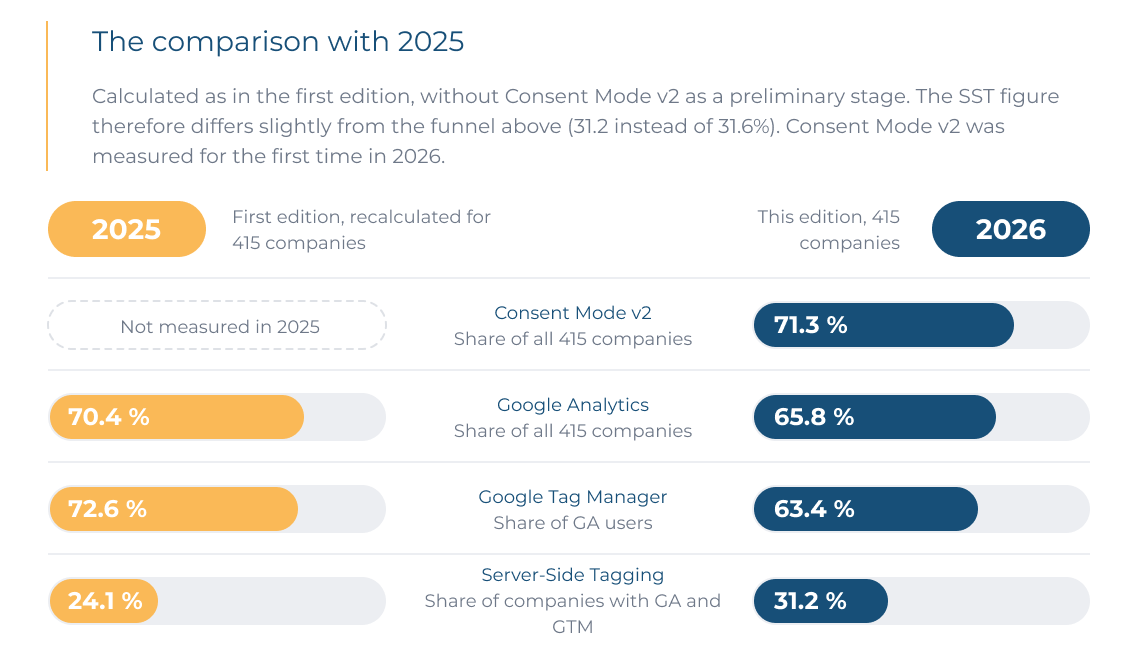
Figure: The comparison with 2025, calculated as in the first edition.
Prior-year figures have been recalculated against the comparable analysis base of 415 companies and therefore differ marginally from those published in the first edition.