Frequency Management Across Screens: How to Run CTV Campaigns Without Ad Fatigue
Frequency Management Across Screens: How to Run CTV Campaigns Without Ad Fatigue
Connected TV is the fastest-growing channel in digital advertising. In Europe, CTV has become the number one delivery channel for premium video advertising in 2026, with ad views growing 23% year-over-year. In Germany alone, the addressable TV market has surpassed €500 million in revenue, with more than 14.5 million addressable devices – while linear TV lost €722 million (–4.2%) in ad spend in 2025.
The shift is real. The budgets are moving. And so is the problem that comes with them.
According to eMarketer analyst Ross Benes, ad overexposure is "the biggest bugaboo in streaming." As more brands pile into CTV inventory, the risk of showing the same ad to the same household – on the living room screen, the smartphone, the laptop – is growing fast. And unlike overexposure on linear TV, which at least stays on one screen, CTV overexposure is invisible to most standard frequency management setups.
The Paradox at the Heart of CTV Advertising
Here's a fact that sounds reassuring at first: people who saw an ad six times had a 92% recall rate, according to a Nexxen study. That's impressive brand awareness. But here's the catch – purchase intent dropped by 16% between the first and sixth exposure.
More frequency can lead to more recognition and less likelihood to buy at the same time.
This is the ad fatigue paradox. The sweet spot – enough exposure to be remembered, not so much to be resented – can be narrow. And in fragmented CTV environments, it's remarkably easy to overshoot.
One case that can show how high frequency can drive results: The Temu Super Bowl case “Shop like a billionaire”. The brand played the same spot five times during the game and saw a 45% spike in app downloads. But that was a single live event, a captive national audience, and a brand with near-zero prior awareness. It's the exception, not the template. In day-to-day CTV campaign management, the math looks very different.
Why Standard Frequency Capping Falls Short
According to a 2024 study by Advertiser Perceptions and Premion, most common concerns of CTV/OTT advertisers are about transparency (39%),fragmentation (39%), and ad frequency management (37%). It reflects a structural gap in how CTV inventory is bought.
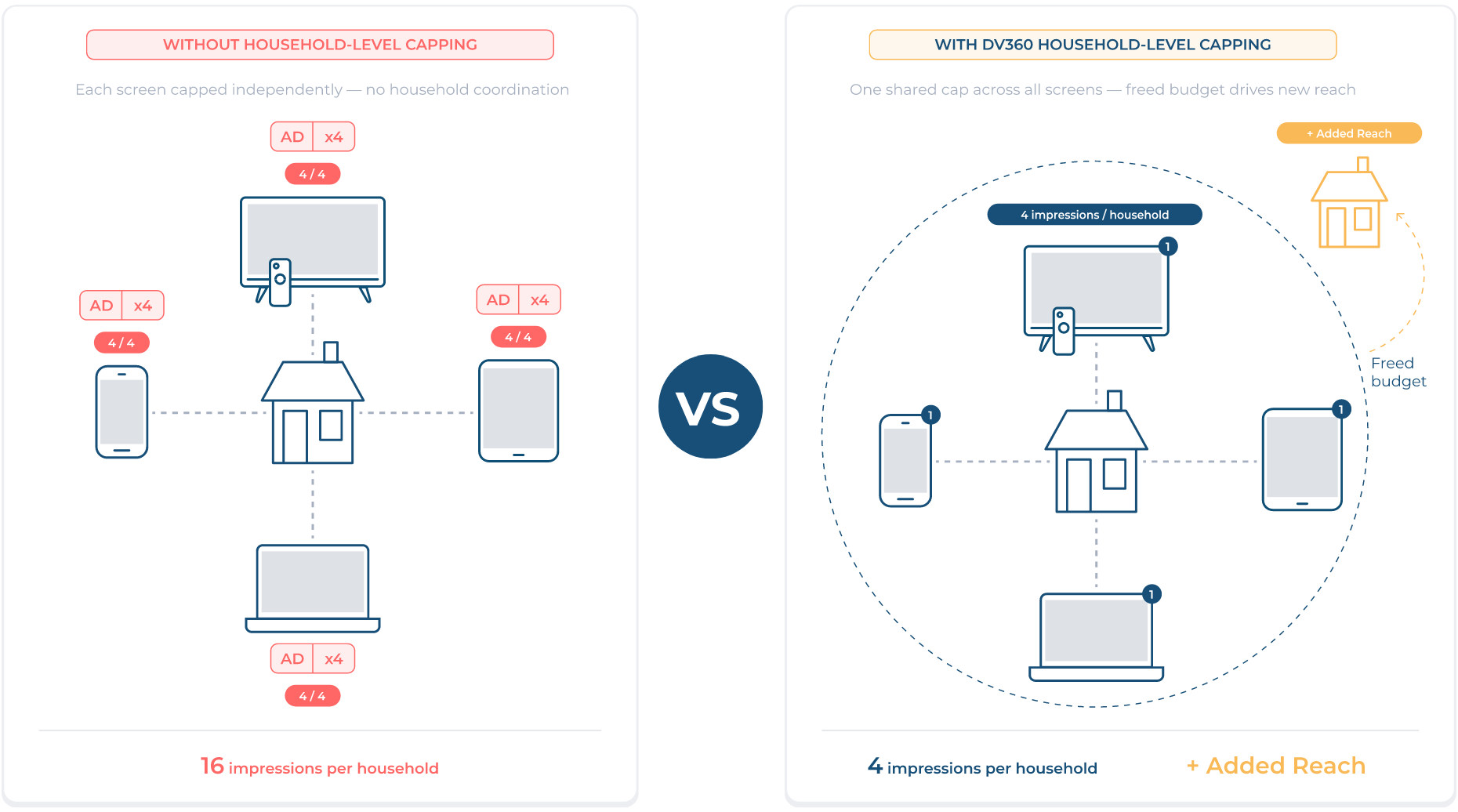
The root issue: CTV is a shared screen. A household might have one smart TV but three people, two smartphones, a tablet, and a laptop – all connected to the same network and exposed to the same campaign. Traditional, cookie-based frequency caps operate at the device level. They don't know that the person who saw your ad on the TV is the same person who just saw it on their phone. They don't know that three different line items across three different publishers are each hitting the same household independently, each with its own cap of four exposures per week.
Add in the complexity of live sports – with unpredictable audience spikes in very short time windows – and the conditions for frequency runaway are almost built in.
This is what advertisers describe when they say a campaign "felt off": a client reaches out because they've been targeted by their own brand's ad at uncomfortably high frequency. The cap was technically respected. On each individual device. Just not across the household.
The Solution: Household-Level Frequency Management in DV360
The structural fix to a structural problem requires moving the unit of control from the device to the household.
Display & Video 360 (DV360) introduced cross-device frequency management earlier this year that, as Google describes it, "understands household-level signals to maximize impact and prevent ad fatigue across all inventory and devices." The system uses Google's identity graph alongside publisher signals to apply a single frequency rule across all devices sharing a household network – spanning YouTube CTV, external broadcaster inventory, and display placements in one unified cap.
This matters especially for live sports. DV360's January 2026 update announced access to programmatic inventory from major sports broadcasters and paired it with real-time bidding capabilities where household-level frequency control holds even during sudden audience peaks. Brands can now compete for high-reach live sports moments without the risk of hammering the same living room with six impressions in ninety minutes.
Also part of the update: Cross-device Conversion – a Google AI-powered feature that connects a CTV impression directly to a downstream purchase, giving marketers real-time ROI visibility into their live CTV campaigns at no additional cost. This closes the loop between frequency control (don't over-expose) and business outcome (did it drive results).
Knowing Where You're Doubling Up: The Overlap Reach Report
Household-level capping solves the execution problem. But it doesn't tell you where your budget is currently being wasted on duplicate reach. That's where measurement comes in.
The Overlap Reach Report in DV360 breaks down how much audience overlap exists between different platforms, publishers, or line items – for example, between YouTube CTV and a broadcaster like RTL+. It shows which households are being reached by both, how often, and what share of your budget is going towards audiences you've already covered.
For campaign managers, this turns a vague sense of inefficiency into a concrete optimization lever. You can set frequency exclusions based on real overlap data, consolidate deals where duplication is highest, and reallocate budget toward inventory that genuinely extends reach. Making the Overlap Reach Report part of every post-campaign analysis helps you accurately evaluate whether your CTV investment is building breadth or just depth.
The Real Goal: Added Reach, Not Repeated Exposure
Once you've capped frequency at the household level and identified where overlap occurs, the question shifts: where is that freed-up budget actually going?
The answer, ideally, is Added Reach – the incremental audience that could only be reached through CTV and not through any other channel. This is particularly valuable for cord-cutters: viewers who have abandoned linear TV entirely and are unreachable through traditional broadcast. In the DACH region, 53% of CTV viewers say they accept advertising in exchange for free premium content, according to the 9th Goldbach Advanced TV Study (2026). FAST channels (Free Ad-Supported Streaming TV) are booming across Germany, Austria, and Switzerland, driven by subscription fatigue. These audiences are available. Frequency-efficient buying is what gets you in front of them instead of the same household you've already hit four times this week.
What This Means in Practice
Three concrete takeaways for CTV campaign setup:
For campaign operations: Consolidate your CTV and YouTube budgets in a single platform like DV360. Only with central, household-level capping do you retain actual control over contact frequency – not just theoretical control at the device level.
For reporting and controlling: Build the Overlap Reach Report into your standard post-campaign workflow. Without measuring cross-platform duplication, you cannot reliably assess your true Added Reach. What looks like broad distribution might be the same 200,000 households, repeatedly.
For leadership: Buying Connected TV like linear television – without intelligent frequency management – burns budget and risks building negative brand associations. The technology to do better exists and is available today.
Ad fatigue is avoidable
CTV's growth is an opportunity. Ad fatigue is the tax you pay for ignoring frequency. The brands that win in connected TV aren’t necessarily those with the biggest budgets – but the ones that understand where their ads are landing, how often, and whether the next impression is buying them a new viewer or just annoying an existing one.
Household-level frequency management, the Overlap Reach Report, and a focus on Added Reach are another step in 2026, how technology keeps on driving activation on the big screen.
Related Articles
Related Articles
About Conversational Analytics in Data Studio
About Conversational Analytics in Data Studio

Campaign Data Import Validation For GA
Campaign Data Import Validation For GA
New Native Google Analytics Dashboard
New Native Google Analytics Dashboard